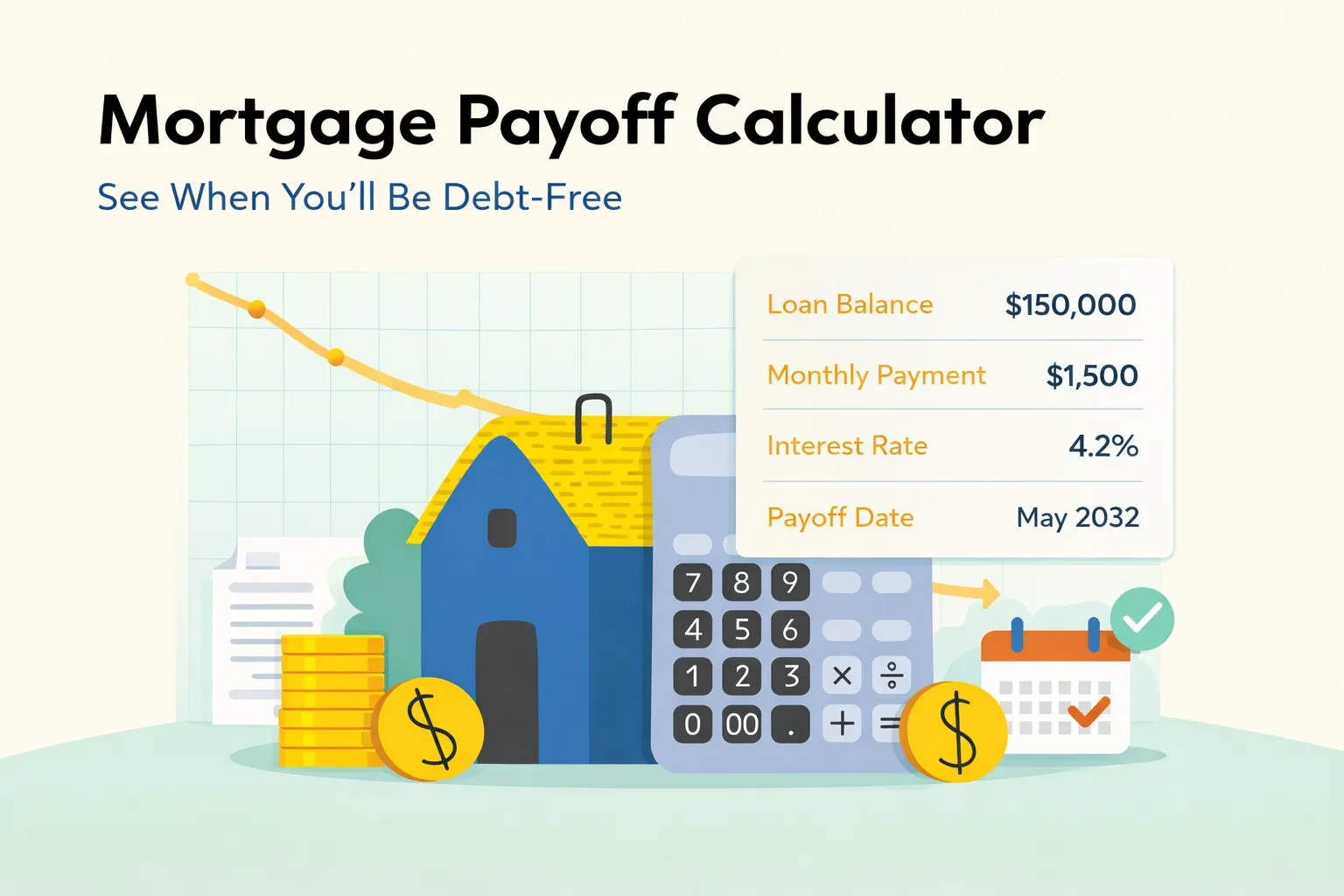
What is a Mortgage Payoff Calculator?
A mortgage payoff calculator is a financial tool that shows you how extra payments can dramatically reduce your mortgage term and save you thousands in interest. Whether you're making extra monthly payments, annual lump sums, or one-time contributions, this calculator reveals the true impact on your loan timeline and total costs.
This free mortgage payoff calculator with extra payments helps you answer critical questions: How much faster can I pay off my mortgage? How much interest will I save? What's the best strategy for extra payments? According to the Consumer Financial Protection Bureau, making extra principal payments is one of the most effective ways to build home equity faster and reduce long-term interest costs.
Many homeowners search for "mortgage early payoff calculator" or "early mortgage payoff calculator" to understand their options. This tool provides instant calculations showing your standard payoff timeline versus accelerated payoff with extra payments, helping you make informed decisions about your mortgage strategy.
Key Benefit:
Studies show that paying just $100 extra per month on a $300,000 mortgage at 6% can save over $50,000 in interest and shorten the loan by 5+ years.
How to Calculate Mortgage Payoff Amount
Calculating your mortgage payoff amount involves understanding amortization—how your payments are split between principal and interest over time. Here's how to calculate mortgage payoff step by step:
- Calculate your monthly payment: Use the formula M = P[r(1+r)^n]/[(1+r)^n-1] where P is principal, r is monthly rate, n is number of payments
- Build an amortization schedule: Track how much of each payment goes to principal vs. interest
- Add extra payments: Apply additional amounts directly to principal, recalculating the remaining balance
- Determine new payoff date: Find when the principal balance reaches zero with extra payments
- Calculate interest saved: Compare total interest paid with and without extra payments
This mortgage loan payoff calculator automates these complex calculations, giving you instant results. No need to manually calculate mortgage payoff—just enter your loan details and see your personalized payoff timeline. If you're also considering using home equity, check our HELOC calculator to explore your options.
How Do Extra Mortgage Payments Work?
Extra mortgage payments work by reducing your principal balance faster than the standard amortization schedule. Since interest is calculated on the remaining principal, every dollar you pay extra reduces future interest charges. This mortgage calculator with extra payments shows you exactly how this works.
Types of Extra Payments
💰 Extra Monthly
Add a fixed amount to every monthly payment. Most consistent and impactful strategy.
Example: +$200/month
📅 Extra Yearly
Make one large payment annually, often from bonuses or tax refunds.
Example: +$5,000/year
🎯 One-Time
Single lump sum payment from inheritance, sale, or windfall.
Example: $20,000 now
Important: Always specify that extra payments should go toward principal, not future payments. Some lenders may apply extra amounts to interest or advance your due date instead of reducing principal.
Use this mortgage payoff calculator extra payments tool to compare different strategies and find the approach that works best for your budget and goals.
How to Pay Off Mortgage Faster
Paying off your mortgage faster requires a strategic approach. Here are proven methods to accelerate your mortgage payoff:
1️⃣ Bi-Weekly Payments
Pay half your monthly payment every two weeks. You'll make 26 half-payments (13 full payments) per year instead of 12, shaving years off your mortgage.
2️⃣ Round Up Payments
If your payment is $1,847, round up to $2,000. The extra $153/month adds up to significant interest savings over time.
3️⃣ Apply Windfalls
Use tax refunds, bonuses, or inheritance toward principal. One-time payments have outsized impact early in the loan.
4️⃣ Refinance to Shorter Term
Refinance from 30-year to 15-year mortgage. Higher payments but massive interest savings. Compare using our mortgage calculator.
5️⃣ Recast Your Mortgage
Make a large principal payment and have your lender recalculate your monthly payment. Lower payments with same term.
6️⃣ Cut Expenses
Redirect savings from cutting subscriptions, dining out, or other expenses directly to your mortgage principal.
Use this early mortgage payoff calculator to model different strategies and see which approach saves you the most money. Even small extra payments can have a dramatic impact over the life of your loan.
How Much Interest Can I Save?
The amount of interest you can save depends on your loan amount, interest rate, remaining term, and extra payment amount. Here's a quick reference guide showing potential savings:
| Loan Amount | Extra Monthly | Interest Saved | Time Saved |
|---|---|---|---|
| $200,000 | $100 | $28,000 | 3.5 years |
| $200,000 | $200 | $48,000 | 6 years |
| $300,000 | $100 | $42,000 | 3.5 years |
| $300,000 | $300 | $98,000 | 7.5 years |
| $400,000 | $200 | $75,000 | 5 years |
| $400,000 | $500 | $155,000 | 9 years |
*Assumes 30-year mortgage at 6% interest rate. Your actual savings will vary based on your specific loan terms.
Use this mortgage payoff calculator to see your exact savings based on your loan details and extra payment strategy. The results might surprise you—even modest extra payments can save tens of thousands in interest.
Should I Pay Off My Mortgage Early?
Paying off your mortgage early isn't right for everyone. Consider these factors before committing to an accelerated payoff strategy:
✅ Good Reasons to Pay Off Early
- • High interest rate (above 5-6%)
- • No high-interest debt (credit cards)
- • Fully funded emergency fund (6+ months)
- • Maxing out retirement contributions
- • Peace of mind is worth more than returns
- • Approaching retirement age
- • Strong cash flow and job security
❌ Reasons to Invest Instead
- • Low interest rate (below 4%)
- • Not maxing retirement accounts
- • No emergency fund established
- • High-interest debt exists
- • Can earn higher returns investing
- • Need liquidity for opportunities
- • Benefit from mortgage tax deduction
The Math: If your mortgage rate is 3.5% and you can earn 8% in the stock market, you're better off investing. But if your rate is 6.5%, paying off the mortgage guarantees a 6.5% "return" with zero risk.
Use this calculator to see the numbers for your situation. For retirement planning, also check our Coast FIRE calculator to see if you can stop saving for retirement.
Mortgage Payoff Calculation Formulas
Standard mortgage amortization formulas with extra payment adjustments:
- Monthly Payment = P × [r(1+r)^n] ÷ [(1+r)^n - 1]
- Where P = Principal, r = Monthly Rate, n = Number of Payments
- Extra Payment Applied: New Balance = Previous Balance - (Principal Payment + Extra Payment)
- Interest Saved = Total Interest (Standard) - Total Interest (With Extra Payments)
- Time Saved = Original Term - New Payoff Term
Example Mortgage Payoff Calculation
$300,000 mortgage at 6.5% for 30 years with $200 extra monthly payment:
Frequently Asked Questions
How much faster can I pay off my mortgage with extra payments?
Extra payments can significantly reduce your mortgage term. For example, adding just $200/month to a $300,000 mortgage at 6.5% can save 6-7 years and over $90,000 in interest. The exact savings depend on your loan amount, interest rate, and extra payment amount.
Do extra mortgage payments reduce interest?
Yes! Extra payments go directly toward your principal balance, reducing the amount of interest you pay over the life of the loan. Since interest is calculated on your remaining balance, lowering the principal faster means less interest accrues each month.
How is mortgage payoff calculated?
Mortgage payoff is calculated using amortization formulas. Each payment includes principal and interest. Extra payments reduce the principal faster, which decreases future interest charges and shortens the loan term. This calculator shows exactly how extra payments affect your payoff timeline.
Should I make extra mortgage payments or invest?
It depends on your mortgage rate vs. potential investment returns. If your rate is high (6%+), paying off the mortgage may be better. If your rate is low (3-4%), investing might yield higher returns. Consider your risk tolerance and financial goals. This calculator helps you see the guaranteed savings from extra payments.
What's the best way to pay off a mortgage early?
The most effective strategies are: (1) Make extra monthly payments toward principal, (2) Make one extra payment per year (13 payments instead of 12), (3) Apply windfalls (bonuses, tax refunds) to principal, (4) Refinance to a shorter term if rates are favorable. Even small extra payments make a big difference over time.
How do I calculate my mortgage payoff amount?
Your mortgage payoff amount is your current principal balance plus any accrued interest through the payoff date. This calculator shows your projected payoff date and total amount paid based on your payment schedule. Contact your lender for your exact current payoff amount.
Will extra payments reduce my monthly payment?
No, extra payments don't reduce your required monthly payment—they reduce your loan term and total interest paid. Your regular payment stays the same, but you'll pay off the loan faster. To reduce monthly payments, you'd need to refinance.
Can I make extra mortgage payments anytime?
Most mortgages allow extra payments without penalty, but check your loan terms for prepayment penalties. Specify that extra payments should go toward principal, not future payments. Some lenders have specific procedures for applying extra payments.
How much should I pay extra on my mortgage?
Pay what you can comfortably afford after covering emergency savings and high-interest debt. Even $50-100/month makes a difference. This calculator lets you experiment with different amounts to see the impact on your payoff timeline and interest savings.
Related Calculators
Explore more tools to help with your calculations
HELOC Calculator 2026 | Free Payment Estimates
Calculate HELOC payments, interest costs, and payoff timeline. Free HELOC calculator with interest-only and amortization schedules for home equity lines of credit.
Home Equity Loan Calculator 2026 | Free Estimates
Use our home equity loan calculator to estimate monthly payments, interest, and borrowing limits. Learn how to calculate home equity loans step-by-step with examples.
CD Calculator 2026 | Maximize Your Returns Now
Use a CD calculator to estimate your earnings, compare CD rates, and maximize returns in 2026. Includes formulas, examples, and expert strategies.