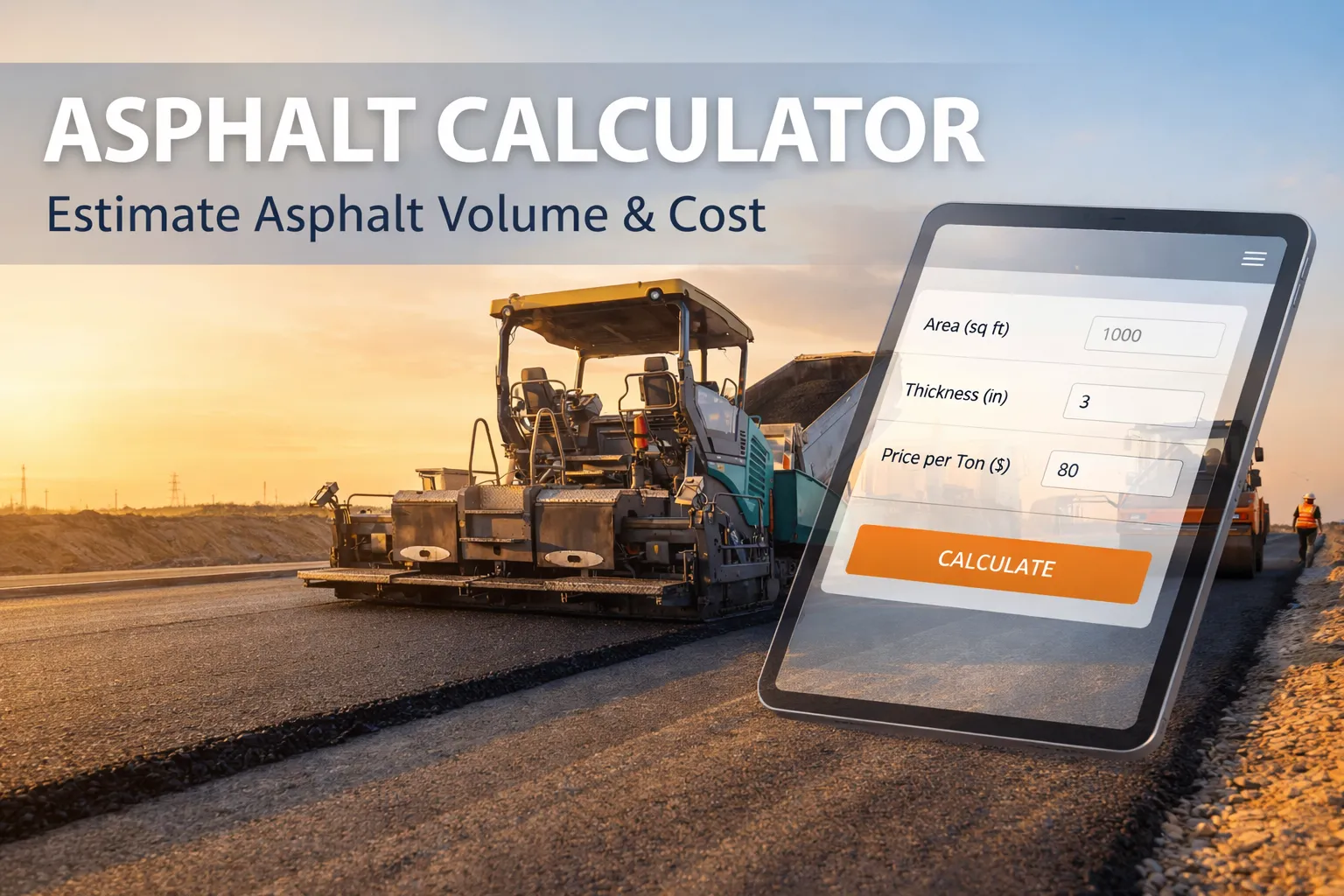
Asphalt Calculator – How Many Tons Do I Need? (Cost Estimate) | CalcZenith
Calculate asphalt tonnage, volume, and cost for driveways, parking lots, and roads. Free asphalt calculator with real-time results and smart recommendations.
Quick Answer
To calculate asphalt tonnage: multiply length × width to get area, then multiply by thickness to get volume, then multiply by density (2,400 kg/m³). For a 20m × 10m driveway with 5cm thickness, you need 24 tons. At $150/ton, that's $3,600.
Quick Start Presets
Choose a common scenario to get started instantly
Calculate Your Project
Enter your dimensions for instant, accurate results
Dimensions
Measure the area to be paved
Material Properties
Standard asphalt specifications
Cost Estimation
Calculate your project budget
Results
Your project requires a moderate amount of asphalt. We recommend ordering 10% extra to account for waste and compaction.
Your Personalized Summary
You need approximately 24.0 tons of asphalt, costing around $3,600. For best results, consider ordering 26.4 tons to cover material loss and compaction.
How Much Asphalt Do I Need?
Calculating the right amount of asphalt for your project is crucial for budgeting and ensuring you have enough material. The amount of asphalt you need depends on three key factors: the area to be paved (length × width), the thickness of the asphalt layer, and the density of the asphalt mix.
For residential driveways, you typically need 5-7.5 cm (2-3 inches) of asphalt thickness. Commercial applications and roads require 10-15 cm (4-6 inches) for durability under heavy traffic. Our calculator automatically converts your measurements and provides accurate tonnage estimates based on standard asphalt density of 2,400 kg/m³.
Always order 5-10% extra asphalt to account for material waste, uneven surfaces, and compaction. This ensures you won't run short during your paving project.
How Much Asphalt Do I Need?
Calculating the right amount of asphalt for your project is crucial for budgeting and ensuring you have enough material. The amount of asphalt you need depends on three key factors: the area to be paved (length × width), the thickness of the asphalt layer, and the density of the asphalt mix.
For residential driveways, you typically need 5-7.5 cm (2-3 inches) of asphalt thickness. Commercial applications and roads require 10-15 cm (4-6 inches) for durability under heavy traffic. According to the National Asphalt Pavement Association (NAPA), proper thickness is critical for long-term performance and can extend pavement life by 50% or more.
Our calculator automatically converts your measurements and provides accurate tonnage estimates based on standard asphalt density of 2,400 kg/m³. Whether you're planning a small driveway project or a large commercial parking lot, this tool gives you precise material requirements.
Always order 5-10% extra asphalt to account for material waste, uneven surfaces, and compaction. This ensures you won't run short during your paving project.
When Should I Repave My Driveway?
Knowing when to repave your asphalt driveway can save you money and prevent more extensive damage. Here are the key signs it's time for repaving:
🚨 Critical Signs
- • Extensive cracking (25%+ of surface)
- • Multiple potholes or depressions
- • Severe drainage problems
- • Crumbling edges or base failure
- • Age over 20 years
⚠️ Warning Signs
- • Fading color (oxidation)
- • Small cracks (can be sealed)
- • Minor surface wear
- • Pooling water in spots
- • Age 15-20 years
According to NAPA, properly maintained asphalt driveways last 15-20 years, while neglected ones may fail in 10-12 years. Regular seal coating every 2-3 years can extend lifespan by 5-10 years and delay the need for costly repaving. Industry statistics show that homeowners who seal coat regularly save an average of $3,000-$5,000 over the lifetime of their driveway compared to those who don't maintain it.
Use this calculator to estimate the cost of repaving before the damage becomes severe. Early planning helps you budget appropriately and choose the right contractor. If you're also planning other construction projects, check our concrete calculator for complementary work like sidewalks or patios.
Is Asphalt Better Than Concrete for Driveways?
The choice between asphalt and concrete depends on your budget, climate, and long-term plans. Here's a detailed comparison:
| Factor | Asphalt | Concrete |
|---|---|---|
| Initial Cost | $3-5 per sq ft ✅ | $5-10 per sq ft |
| Lifespan | 15-20 years | 30-40 years ✅ |
| Maintenance | Seal every 2-3 years | Minimal ✅ |
| Repair Cost | Low, easy patches ✅ | High, visible repairs |
| Cold Climate | Excellent, flexible ✅ | Cracks in freeze/thaw |
| Hot Climate | Can soften in heat | Excellent ✅ |
| Appearance | Black, uniform | Customizable ✅ |
| Installation Time | 1-2 days ✅ | 3-7 days (curing) |
Choose Asphalt if: You're on a budget, live in a cold climate, want quick installation, or plan to move within 15 years.
Choose Concrete if: You want long-term investment, live in a hot climate, prefer low maintenance, or want decorative options. If you're considering concrete, check our concrete calculator for cost comparison.
How Long Does Asphalt Take to Cure?
Understanding asphalt curing time is essential for protecting your investment and ensuring long-term durability. Here's a complete timeline:
Light Traffic (24-48 hours)
You can walk on asphalt after 24 hours and drive passenger vehicles after 48 hours. Avoid sharp turns and heavy braking.
Normal Use (7 days)
After one week, you can use the driveway normally. Avoid parking heavy vehicles (RVs, trucks) or turning wheels sharply while stationary.
Seal Coating Ready (90 days)
Wait at least 90 days before applying seal coat. This allows proper curing and off-gassing of petroleum oils.
Full Cure (6-12 months)
Complete curing takes 6-12 months depending on weather. The asphalt continues to harden and reach maximum strength during this period.
Pro Tip:
Avoid parking in the same spot repeatedly during the first 6 months. This prevents indentations and ensures even curing across the entire surface.
Studies show that properly cured asphalt lasts 30-40% longer than asphalt subjected to heavy use too early. Patience during the curing period pays off with decades of reliable performance. For budgeting your home improvement projects, explore our HELOC calculator to see financing options.
Asphalt Calculation Formula
Understanding how to calculate asphalt tonnage helps you verify estimates and plan your project accurately. Here's the step-by-step formula:
- Calculate Area: Multiply length by width (Area = Length × Width)
- Calculate Volume: Multiply area by thickness (Volume = Area × Thickness)
- Calculate Weight: Multiply volume by asphalt density (Weight = Volume × 2,400 kg/m³)
- Convert to Tons: Divide weight by 1,000 to get metric tons
- Calculate Cost: Multiply tons by cost per ton
For example, a 20m × 10m driveway with 5cm thickness: Area = 200 m², Volume = 10 m³, Weight = 24,000 kg = 24 tons. At $150/ton, total cost = $3,600.
Asphalt Cost Per Square Foot
Asphalt paving costs vary by region, project size, and thickness. On average, asphalt costs $3-$7 per square foot installed, including materials and labor. Material-only costs range from $100-$200 per ton. According to industry data from 2024, the national average for residential asphalt installation is $4.50 per square foot, though prices in high-cost areas like California and New York can reach $8-$10 per square foot.
| Area (sq ft) | Tons Needed | Material Cost | Total Installed |
|---|---|---|---|
| 500 | 3 | $450–$750 | $1,500–$3,500 |
| 1,000 | 6 | $900–$1,500 | $3,000–$7,000 |
| 2,000 | 12 | $1,800–$3,000 | $6,000–$14,000 |
| 5,000 | 30 | $4,500–$7,500 | $15,000–$35,000 |
Note: Installed costs include site preparation, grading, base layer, asphalt application, and compaction. Prices vary by location and project complexity. For comparison with other paving materials, see our concrete calculator to evaluate concrete paving costs.
Asphalt Driveway Cost Examples
Here are real-world examples of asphalt driveway costs for common residential projects:
🏠 Single Car Driveway
- • Size: 10m × 3m (33ft × 10ft)
- • Thickness: 5cm (2 inches)
- • Tons needed: 3.6 tons
- • Material cost: $540-$720
- • Total installed: $1,800-$4,200
🚗 Double Car Driveway
- • Size: 20m × 6m (66ft × 20ft)
- • Thickness: 7.5cm (3 inches)
- • Tons needed: 21.6 tons
- • Material cost: $3,240-$4,320
- • Total installed: $7,200-$16,800
🏘️ Long Driveway
- • Size: 50m × 4m (164ft × 13ft)
- • Thickness: 7.5cm (3 inches)
- • Tons needed: 36 tons
- • Material cost: $5,400-$7,200
- • Total installed: $12,000-$28,000
🅿️ Small Parking Area
- • Size: 15m × 10m (49ft × 33ft)
- • Thickness: 10cm (4 inches)
- • Tons needed: 36 tons
- • Material cost: $5,400-$7,200
- • Total installed: $9,000-$21,000
Tips to Reduce Asphalt Costs
Save money on your asphalt paving project with these professional tips:
Time Your Project Right
Schedule paving in late spring or summer when asphalt plants are busiest and prices are lower.
Prepare the Site Yourself
Clear vegetation, remove old pavement, and level the area to reduce labor costs.
Get Multiple Quotes
Compare at least 3-5 contractor quotes to ensure competitive pricing and quality work.
Consider Recycled Asphalt
Recycled asphalt (RAP) costs 20-30% less and is environmentally friendly.
Optimize Thickness
Use minimum recommended thickness for your use case—don't over-engineer residential driveways.
Maintain Properly
Seal coat every 2-3 years to extend lifespan and avoid costly repairs or replacement.
Asphalt Calculation Formula
Our calculator uses industry-standard formulas to determine asphalt requirements accurately:
- Area = Length × Width
- Volume = Area × Thickness
- Weight (tons) = Volume × Density ÷ 1000
- Total Cost = Weight × Cost per Ton
Example: Residential Driveway
For a standard residential driveway measuring 20m × 10m with 5cm thickness:
Frequently Asked Questions
How do I calculate asphalt tonnage?
To calculate asphalt tonnage: (1) Calculate area (length × width), (2) Calculate volume (area × thickness), (3) Multiply volume by asphalt density (typically 2,400 kg/m³ or 145 lbs/ft³), (4) Convert to tons. Our calculator does this automatically with real-time results.
How thick should asphalt be?
Residential driveways: 5-7.5 cm (2-3 inches). Commercial driveways and light parking: 7.5-10 cm (3-4 inches). Heavy traffic roads and parking lots: 10-15 cm (4-6 inches). Our calculator recommends appropriate thickness based on your project type.
How much does asphalt cost per ton?
Asphalt costs typically range from $100-$200 per ton depending on location, quality, and market conditions. Hot mix asphalt (HMA) averages $150/ton. Prices vary by region and season, with lower prices often available in summer months.
Can I calculate asphalt for a driveway?
Yes! Our calculator is perfect for driveways. Simply enter your driveway dimensions (length and width), choose your desired thickness (typically 5-7.5cm for residential), and get instant results for tons needed and estimated cost.
How much extra asphalt should I order?
We recommend ordering 5-10% extra asphalt to account for material waste, uneven surfaces, compaction, and measurement variations. Our calculator includes smart recommendations based on your project size.
What is the density of asphalt?
Standard asphalt density is approximately 2,400 kg/m³ (145 lbs/ft³). This can vary slightly based on mix design and aggregate type. Our calculator uses industry-standard density values for accurate tonnage calculations.
When should I repave my driveway?
Repave your asphalt driveway when you see extensive cracking (more than 25% of surface), potholes, drainage issues, or fading color. Typically, asphalt driveways last 15-20 years with proper maintenance. Seal coating every 2-3 years can extend lifespan significantly.
Is asphalt better than concrete for driveways?
Asphalt is typically 30-50% cheaper than concrete, easier to repair, and better in cold climates (less cracking). Concrete lasts longer (30-40 years vs 15-20 years) and requires less maintenance. Asphalt is better for budget-conscious projects and cold regions, while concrete is better for long-term investment in warm climates.
How long does asphalt take to cure?
Asphalt can be driven on after 24-48 hours, but full curing takes 6-12 months. Avoid parking heavy vehicles or turning wheels sharply for the first week. Wait at least 90 days before seal coating new asphalt to allow proper curing and off-gassing.
Related Calculators
Explore more tools to help with your calculations
Concrete Calculator 2026 | Yards, Bags & Cost
Calculate the amount of concrete needed for slabs, footings, columns, and other projects.
Concrete Calculator 2026 | Yards, Bags & Cost
Calculate the amount of concrete needed for slabs, footings, columns, and other projects.
Asphalt Calculator 2026 | Tons & Cost Instantly
Calculate the amount of asphalt needed for your paving project based on area and thickness.